
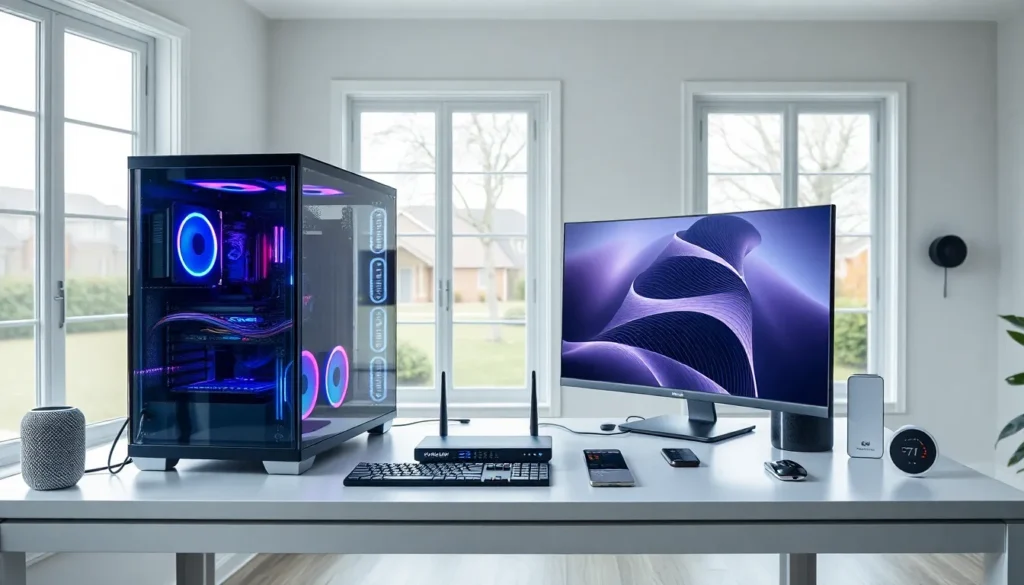
The top hardware of 2025 delivers faster speeds, better efficiency, and smarter features than ever before. Whether someone builds a gaming rig, upgrades a home network, or automates their living space, the right hardware makes all the difference. This guide covers the best computing components, networking devices, storage solutions, and smart home gadgets available right now. Each category includes specific recommendations that balance performance with value. By the end, readers will know exactly which top hardware fits their setup and budget.
Table of Contents
ToggleKey Takeaways
- The top hardware of 2025 includes AMD Ryzen 9 9950X and Intel Core Ultra 9 285K processors, paired with NVIDIA RTX 5090 or AMD Radeon RX 8900 XTX graphics cards for peak performance.
- Wi-Fi 7 routers like the TP-Link Archer BE900 deliver speeds up to 46 Gbps, while mesh systems cover 6,000+ square feet without dead zones.
- PCIe 5.0 NVMe SSDs now reach read speeds above 14,000 MB/s, though PCIe 4.0 drives offer excellent value for most users.
- Smart home devices using the Matter standard now work seamlessly across Apple, Google, Amazon, and Samsung ecosystems.
- Always match your top hardware choices to specific use cases—gamers should prioritize graphics cards, while data-heavy users should focus on storage solutions.
- Future-proof your setup by choosing components with PCIe 5.0 support, DDR5 memory, and Wi-Fi 7 compatibility.
Best Computing Hardware for Performance
High-performance computing starts with the processor. In 2025, AMD’s Ryzen 9 9950X and Intel’s Core Ultra 9 285K lead the pack for desktop users. Both chips offer excellent multi-threaded performance and improved power efficiency over their predecessors. Gamers and content creators will notice the difference immediately.
Graphics cards remain essential for demanding tasks. NVIDIA’s RTX 5090 dominates the high-end market with its next-generation architecture. AMD’s Radeon RX 8900 XTX offers strong competition at a lower price point. Either option handles 4K gaming and AI workloads with ease.
RAM matters too. DDR5 memory has matured significantly, with 6400MHz kits now hitting mainstream prices. Most users benefit from 32GB, though video editors and 3D artists should consider 64GB configurations.
Motherboards tie everything together. Look for boards with PCIe 5.0 support, multiple M.2 slots, and quality VRM cooling. ASUS, MSI, and Gigabyte all produce reliable options across various price ranges.
Top hardware in this category also includes premium cooling solutions. Air coolers like the Noctua NH-D15 G2 remain popular, but 360mm AIO liquid coolers provide better thermal performance for overclocked systems.
Top Networking and Connectivity Devices
Fast internet means nothing without proper networking hardware. Wi-Fi 7 routers have arrived, and they deliver speeds up to 46 Gbps in ideal conditions. The TP-Link Archer BE900 and ASUS ROG Rapture GT-BE98 represent the top hardware choices for early adopters.
Mesh systems work better for larger homes. The Eero Max 7 and Google Nest WiFi Pro cover 6,000+ square feet without dead zones. They install quickly and manage themselves through smartphone apps.
Wired connections still beat wireless for latency-sensitive applications. 2.5 Gigabit Ethernet switches have dropped in price, making whole-home wired networks more affordable. QNAP and Netgear offer excellent 8-port options under $150.
Network-attached storage (NAS) devices serve dual purposes. They provide central file storage and run various applications. Synology’s DS923+ handles four drives and supports 10GbE upgrades for power users.
Don’t overlook quality Ethernet cables. Cat 6a cables support 10 Gigabit speeds at reasonable distances. They cost slightly more than Cat 5e but future-proof any setup.
Essential Storage Solutions
Storage technology continues to advance rapidly. NVMe SSDs using PCIe 5.0 now reach sequential read speeds above 14,000 MB/s. The Crucial T700 and Samsung 990 Pro represent top hardware in this space.
Not everyone needs bleeding-edge speeds, though. PCIe 4.0 drives like the WD Black SN850X offer excellent performance at lower prices. They work perfectly for gaming, general productivity, and everyday computing.
External storage has improved dramatically. Portable SSDs from Samsung and SanDisk now deliver 2,000+ MB/s through USB 3.2 Gen 2×2 or Thunderbolt connections. They survive drops, resist water, and fit in any pocket.
Traditional hard drives still make sense for bulk storage. 24TB drives from Seagate and Western Digital cost around $400, roughly $16 per terabyte. Video archives and cold storage benefit from this capacity.
Cloud backup complements local storage. Services like Backblaze offer unlimited backup for $99 per year. The combination of local and cloud storage protects against hardware failure and disasters alike.
Smart Home and IoT Hardware
Smart home hardware has grown more reliable and interoperable. The Matter standard now connects devices from different manufacturers seamlessly. Apple, Google, Amazon, and Samsung all support it.
Smart speakers serve as control hubs. The Amazon Echo (5th Gen) and Google Nest Audio respond to voice commands and control compatible devices. Apple’s HomePod mini integrates best with iPhone users.
Smart lighting saves energy and sets moods. Philips Hue remains the top hardware choice for color-changing bulbs, though Nanoleaf offers creative panel designs. Both work with Matter and major voice assistants.
Video doorbells add security and convenience. Ring Video Doorbell 4 and Google Nest Doorbell (battery) record visitors in crisp detail. They send alerts to phones instantly.
Smart thermostats reduce heating and cooling costs. The Ecobee Smart Thermostat Premium and Google Nest Learning Thermostat learn household patterns and adjust automatically. Most users save 10-15% on energy bills.
Smart locks round out home automation. August Wi-Fi Smart Lock and Yale Assure Lock 2 offer keyless entry with remote access. They retrofit onto existing deadbolts in minutes.
How to Choose the Right Hardware for Your Needs
Selecting top hardware requires honest assessment. Start by listing specific use cases. A video editor needs different components than a casual web browser.
Budget constraints shape every decision. Identify which components matter most for particular workflows. Gamers should prioritize graphics cards, while data hoarders focus on storage capacity.
Future-proofing deserves consideration. Hardware that seems overkill today may prove adequate in two years. PCIe 5.0 support, DDR5 memory, and Wi-Fi 7 compatibility extend useful lifespans.
Compatibility matters enormously. Check that motherboards support chosen processors. Verify that cases accommodate desired cooling solutions. Confirm that power supplies deliver sufficient wattage.
Reviews from trusted sources help avoid lemons. Sites like Tom’s Hardware, AnandTech, and Gamers Nexus test products thoroughly. User reviews on retail sites reveal long-term reliability issues.
Warranties and support policies differ between brands. Some manufacturers offer excellent customer service while others frustrate buyers. Research these factors before committing to purchases.