
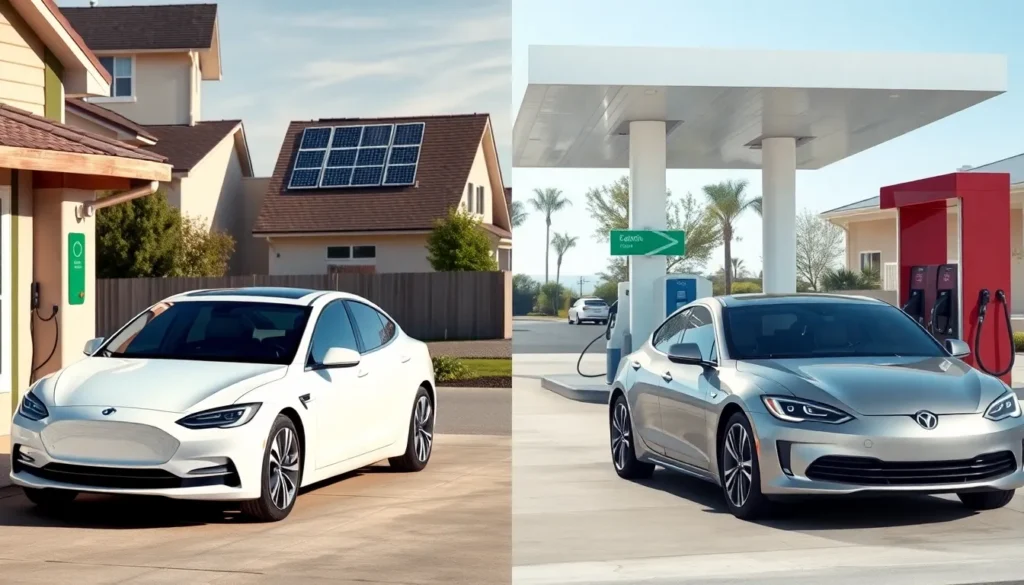
Electric vehicles vs gas cars, it’s a debate that shapes how millions of drivers choose their next car. Gas-powered vehicles have dominated roads for over a century. Electric vehicles (EVs) now challenge that dominance with lower running costs and zero tailpipe emissions. But which option actually makes sense for most drivers?
This comparison breaks down the key differences between electric vehicles vs gas cars. It covers costs, environmental impact, performance, charging options, and maintenance. By the end, drivers can make an well-informed choice based on facts rather than hype.
Table of Contents
ToggleKey Takeaways
- Electric vehicles vs gas cars show EVs cost more upfront, but fuel savings of $8,000+ over 100,000 miles often offset the difference within 3–5 years.
- EVs produce zero tailpipe emissions and generate up to 80% fewer lifetime emissions than gas cars, even when accounting for battery production.
- Electric vehicles deliver instant torque and faster acceleration, with many outperforming sports cars in 0-60 mph times.
- Home charging eliminates the need for gas station visits for daily commuters, adding 25–30 miles of range per hour with a Level 2 charger.
- EV maintenance costs average $500–$700 annually compared to $1,000–$1,500 for gas cars, thanks to fewer moving parts and regenerative braking.
- Most EV batteries retain 80% capacity after 200,000 miles and come with 8-year or 100,000-mile warranties for added peace of mind.
Upfront Costs and Long-Term Savings
Electric vehicles vs gas cars show significant differences in purchase price. EVs typically cost more upfront. The average new EV in 2024 sold for around $56,000, while the average gas car cost about $48,000. That gap has narrowed considerably over the past five years.
Federal tax credits can reduce EV prices by up to $7,500 in the United States. Many states offer additional incentives. These credits make some EVs price-competitive with gas equivalents.
Long-term savings tell a different story. Electricity costs less than gasoline per mile driven. The average American pays about $0.04 per mile to charge an EV at home. Gas cars cost roughly $0.12 to $0.15 per mile for fuel. Over 100,000 miles, that difference adds up to $8,000 or more in savings.
Insurance rates for electric vehicles vs gas cars run slightly higher for EVs. Repair costs for EVs can also be expensive due to specialized parts. But, fuel savings often offset these expenses within three to five years of ownership.
Environmental Impact and Emissions
The environmental comparison between electric vehicles vs gas cars favors EVs in most scenarios. Gas cars emit carbon dioxide directly from their tailpipes. A typical gas car produces about 4.6 metric tons of CO2 annually.
Electric vehicles produce zero direct emissions. Their environmental footprint depends on how their electricity is generated. In states with clean grids, EVs produce 80% fewer lifetime emissions than gas cars. Even in coal-heavy regions, EVs still outperform gas vehicles over their lifespan.
Battery production does require significant resources. Mining lithium, cobalt, and nickel creates environmental concerns. But, studies from the EPA and MIT show that EVs compensate for manufacturing emissions within 18 to 24 months of driving.
Gas cars also require oil extraction, refining, and transportation, processes that generate substantial emissions before fuel even reaches the pump. When accounting for the full supply chain, electric vehicles vs gas cars comparisons consistently favor EVs for lower total carbon output.
Performance and Driving Experience
Electric vehicles vs gas cars offer fundamentally different driving experiences. EVs deliver instant torque. Electric motors reach maximum power immediately. This makes acceleration feel quick and responsive, even in budget-friendly models.
Many EVs outperform sports cars in 0-60 mph times. The Tesla Model 3 Performance hits 60 mph in 3.1 seconds. Few gas cars under $60,000 match that figure.
Gas cars provide a more traditional driving feel. Engine noise, gear shifts, and throttle response create sensations that many drivers enjoy. Performance enthusiasts often prefer the engagement of a manual transmission or the sound of a V8 engine.
Handling differs between the two as well. EVs place heavy battery packs low in the chassis. This lowers the center of gravity and improves stability. Gas cars offer more variation in weight distribution based on engine placement.
Range remains a consideration. Gas cars can travel 300 to 500 miles on a tank. Most EVs offer 200 to 350 miles per charge. Top-tier EVs now exceed 400 miles, closing this gap.
Charging Infrastructure vs Gas Stations
Infrastructure availability shapes the electric vehicles vs gas cars decision for many buyers. The United States has about 150,000 gas stations. EV drivers have access to roughly 68,000 public charging locations with over 180,000 individual ports.
Home charging changes the equation for EV owners. Most drivers charge overnight and start each day with a full battery. A Level 2 home charger costs $500 to $2,000 installed and adds 25 to 30 miles of range per hour.
DC fast chargers can add 200 miles in 20 to 30 minutes. Networks like Tesla Supercharger, Electrify America, and ChargePoint continue expanding. The federal government has allocated $7.5 billion to build 500,000 new chargers by 2030.
Gas stations offer faster refueling, about five minutes for a full tank. They’re also more evenly distributed, especially in rural areas. Long road trips remain easier with gas cars in regions with limited charging infrastructure.
For daily commuters, the electric vehicles vs gas cars infrastructure gap matters less. Someone who drives 40 miles daily can charge at home and never visit a public station.
Maintenance and Reliability Differences
Electric vehicles vs gas cars require very different maintenance routines. EVs have fewer moving parts. No oil changes, transmission fluid, spark plugs, or timing belts. Electric motors contain about 20 moving parts compared to 2,000 in a gas engine.
Brake pads last longer on EVs thanks to regenerative braking. This system captures energy when slowing down and reduces wear on physical brakes. Many EV owners go 100,000 miles before replacing brake pads.
Gas cars need regular maintenance to run properly. Oil changes every 5,000 to 7,500 miles, transmission service, coolant flushes, and exhaust system repairs add up. Annual maintenance costs average $1,000 to $1,500 for gas vehicles versus $500 to $700 for EVs.
Battery longevity concerns some buyers. Most EV batteries come with 8-year or 100,000-mile warranties. Data shows modern batteries retain 80% capacity after 200,000 miles in many cases.
Repair costs can be higher for EVs when something does break. Specialized parts and trained technicians are less common. A damaged battery pack can cost $5,000 to $15,000 to replace, though this remains rare.